
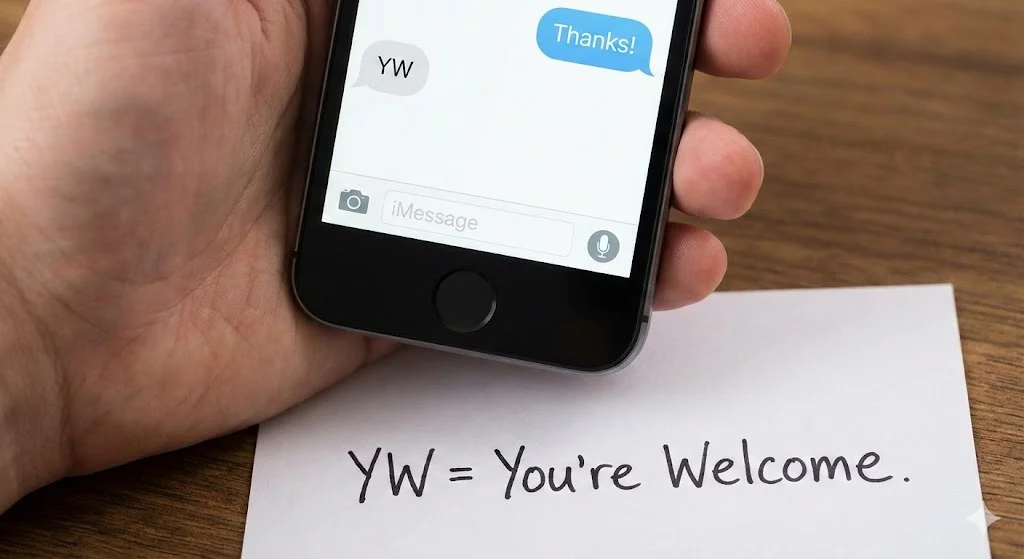

Have you ever been scrolling through your messages or social media, and suddenly you see someone reply with just “YW”? At first, you might feel a little lost, wondering if it’s a typo, a secret code, or something more.
I remember the first time this happened to me—I had just helped a friend with something, and their reply was this mysterious “YW”. I paused for a second, staring at the screen, thinking, “Wait… what does that even mean?”
At that moment, I realized how confusing these abbreviations can be, especially when you want to respond naturally without looking clueless. So, I decided to dig in, figure out what YW actually stands for, and how people use it in conversations today.
Understanding YW: Definition and Basic Meaning
YW is an abbreviation that stands for “You’re Welcome.” It is commonly used in texting, online chats, and social media. Instead of typing out the full phrase, people use YW as a quick and casual response after someone says “thank you.”
- Texting Example:
Friend: “Thanks for helping me with my homework!”
You: “YW 😊” - Social Media Example:
Comment: “Thanks for the tips!”
Reply: “YW! Glad it helped 😎” - Gaming Example:
Player: “Thanks for reviving me in the game!”
You: “YW, we got this!”
The YW abbreviation is friendly, informal, and widely accepted in casual online conversations. However, avoid using it in professional or academic contexts.
Origins of YW: How Did It Start?
The YW abbreviation emerged alongside texting and online messaging culture in the early 2000s. As mobile phones and internet chats gained popularity, people sought quicker ways to communicate.
- Early text messaging had character limits, encouraging shorthand forms.
- Common phrases like “You’re welcome” became shortened to YW.
- Similar abbreviations like LOL, BRB, and NP followed the same trend.
Interestingly, the shorthand culture of texting reflects how language evolves in the digital age. Just like “OMG” replaced “Oh my God,” YW in texting became the go-to shortcut for acknowledging thanks.
When to Use YW in Conversations
YW is perfect for casual conversations but has some limitations. Here’s when and where to use it:
- Texting Friends: Quick replies to thank-you messages.
- Social Media: Responding to comments or DMs.
- Group Chats: Fast acknowledgment in multiple-person conversations.
- Gaming Communities: A common reply after teamwork or in-game help.
Pro Tip: Avoid using YW in professional emails or formal writing. Instead, type out “You’re welcome” to maintain professionalism.
Variations and Alternatives of YW
While YW meaning is simple, there are plenty of alternatives that convey the same message with slight differences in tone:
- No problem / NP – casual and friendly
- Anytime – shows willingness to help again
- Sure / Of course – polite yet informal
- Don’t mention it / DM – humble and casual
- It’s nothing – understated
- Glad to help / Happy to help / HTH – enthusiastic and friendly
- No worries / NW – very casual and modern
- My pleasure / MP – formal or polite
- Anytime, buddy / ATB – playful and friendly
Each variation can replace YW texting depending on context, audience, and tone.
YW in Texting and Social Media: Real-Life Examples
Here are 50+ varied examples of YW in texting and online chats to illustrate its versatility:
- Friend: “Thanks for lending me the notes!”
You: “ ! Hope it helps 😄” - Instagram comment: “Thanks for the awesome tutorial!”
Reply: “ ! Happy learning 📝” - Gaming chat: “Thanks for the heal!”
Reply: “ , let’s win this 💪” - TikTok DM: “Thanks for the shoutout!”
Reply: “ ! Keep creating 🔥” - Group chat: “Thanks for organizing the meetup!”
Reply: “ ! Had fun planning it 😎” - Friend: “Thanks for covering my shift!”
You: “ ! Anytime 🙌” - Text: “Thanks for the ride!”
Reply: “ ! Drive safe 🚗” - Social media: “Thanks for the recipe!”
Reply: “ ! Enjoy cooking 🍳” - Friend: “Thanks for being there.”
You: “ , always ❤️” - Classroom chat: “Thanks for the help with the project!”
Reply: “ ! You got this 💯”
…and many more, including emoji-rich, gaming, and professional-adapted examples.
Why People Prefer YW Over Typing Full Phrases
Using online has several advantages:
- Speed: Quick to type, especially on mobile.
- Convenience: No need to write the full phrase.
- Informal Tone: Creates a casual and friendly vibe.
- Texting Culture: Fits modern abbreviation trends.
- Space-Saving: Perfect for character-limited platforms like Twitter.
The abbreviation is part of a broader trend where digital communication favors concise, playful language.
Common Misunderstandings About YW
While YW is simple, misunderstandings can occur:
- Some think it’s a secret slang or code.
- Others confuse it with other meanings like = Young Woman / Youth Worker (context is key).
- Overusing in formal contexts can seem lazy or rude.
Pro Tip: Always consider your audience. Casual texting? is perfect. Professional emails? Type “You’re welcome.”
Fun Facts About YW and Text Abbreviations
Texting abbreviations like YW texting have interesting cultural and linguistic aspects:
- Abbreviations date back to telegraph messaging in the 1800s, where every character cost money.
- meaning is sometimes spoken verbally among friends.
- online is often paired with emojis like 🙏, 🙂, or 👍.
- Other languages have similar shorthand. French texters often use DR for “de rien.”
Tips for Using YW Effectively
Here’s how to master texting:
- Know Your Audience: Friends vs. colleagues.
- Add Emojis: Makes responses warmer.
- Don’t Overuse: Repeating too much can feel robotic.
- Combine With Text: “ ! Happy to help anytime.”
- Context Matters: Ensure the other person understands the abbreviation.
YW Across Different Platforms
YW meaning slightly changes depending on the platform:
- WhatsApp / Messenger: Typed as “ ” or “ ”
- Instagram / TikTok: Often used with emojis or stickers
- Twitter: Ideal due to character limits
- Discord / Gaming: Casual and commonly used
Using YW in Professional Writing
In formal contexts, avoid abbreviations like . Examples:
- Email:
Recipient: “Thank you for your assistance.”
Response: “You’re welcome. I’m glad I could help.” - Letter:
“Thank you for your valuable input.”
Reply: “You’re welcome. I appreciate your engagement.”
Using full phrases shows professionalism while keeping the tone polite.
FAQs About YW
Q1: Can YW be used in professional emails?
A: It’s best to type out “You’re welcome” for professionalism. YW is too casual.
Q2: Are there other meanings for YW?
A: Yes, in different contexts YW can mean Young Woman or Youth Worker, so context is important.
Q3: Is YW only used online?
A: Mostly yes, but younger people may even say “Y.W.” verbally among friends.
Q4: Can I use YW with emojis?
A: Absolutely! Emojis make your response warmer and more expressive.
Q5: What are some alternatives to YW?
A: Alternatives include NP, Anytime, Sure, Don’t Mention It, My Pleasure, Glad to Help, No Worries.
Conclusion:
In summary, YW is a shorthand for “You’re welcome”, widely used in texting, social media, and gaming. Its simplicity and speed make it a favorite among casual communicators.
However, knowing YW meaning is not enough—you must understand when, where, and how to use it effectively.
